


.png)
Respiratory Tests
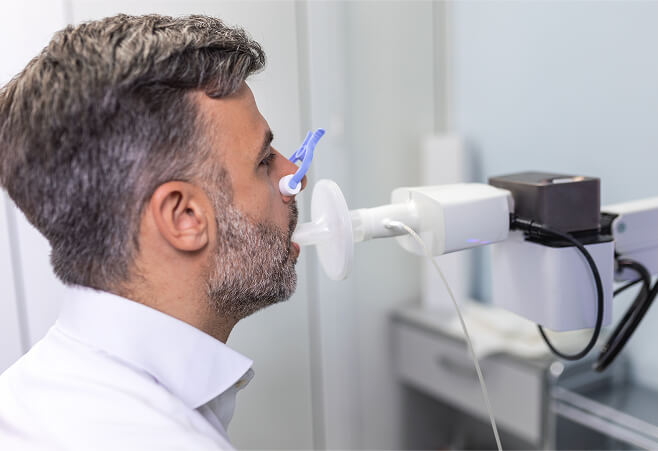
Respiratory tests are essential when assessing a patient’s lung function by measuring key aspects of breathing, including air volume, airflow speed, and gas exchange efficiency. These tests help diagnose conditions such as asthma, Chronic Obstructive Pulmonary Disease (COPD), and pulmonary fibrosis.
Sleep Study Tests Available
Conducted in the comfort of your home, this study measures breathing, oxygen levels, heart rate, brain activity, and muscle activity, helping diagnose sleep disorders and determine effective treatment strategies.
A home-based study which is focused on detecting Obstructive Sleep Apnoea (OSA) or Sleep Disordered Breathing (SDB)
Level four is the most basic type of sleep study, looking at oxygen saturation levels during sleep.
How the Process Works
Sleep Assessment
Treatment
- CPAP (Positive Airway Pressure) therapy
- Nasal EPAP
- Referral to an ENT surgeon
- Weight management
Long term therapy and support
We provide extra support, including rental packages (short or long-term), ongoing monitoring, annual data checks, and reviews. Disability allowance support may be available for those on limited incomes.
Respiratory Test FAQ’s
There are many different reasons to get a lung function test.
Some of the common reasons include:
- To diagnose the cause of a cough or shortness of breath
- To evaluate and monitor lung conditions like asthma and Chronic Obstructive Pulmonary Disease (COPD)
- As a general check-up for lung health especially if you have had exposure to cigarette smoke or other hazardous chemicals
- Perioperative testing – to assess your breathing before a major operation
The Lung function test is a non-invasive procedure. To achieve accurate results, the test requires maximum effort from you to breathe in and out, which means you may feel tired after testing.
Very rarely, spirometry can cause breathing problems. These are easily treated with an inhaled bronchodilator to open the airways. This test should not be performed if there is a history of angina, a recent history of surgery, eye injuries or serious heart disease.
Please contact us if you have any concerns.
You will be required to breathe into a mouthpiece which is connected to a machine via some tubing. The technician will direct you to breathe in as deeply as you can, and then out as fast and as forcefully as possible.
The test may make you feel temporarily short of breath.
A respiratory test takes approximately 30 minutes.
We suggest wearing loose clothing as tight clothing may restrict your breathing.
Please remember to keep your dentures in, wearing them to the test will make sure your mouth can fit tightly around the mouthpiece.
Please bring any medications especially any respiratory inhalers (puffers) with you to your appointment. This may be required for testing the effectiveness of your current medication.
Please avoid the following;
- Avoid drinking beverages containing caffeine 3 hours before your test (including Tea/Coffee/Cola/Energy drinks)
- Avoid a heavy meal for at least 3 hours before your test
- Avoid smoking 3 hours before the test
- Avoid strenuous exercise 3 hours before the test
Avoid taking the following medication;
- Ventolin, Asmol, Bricanyl, Bretaris, Brezhaer for 4 hours prior to test
- Spiriva, Atrovent, and Onbrez for 6 hours
- Pulmicort, Serevent, Symbicort, Seretide, Flixotide, Oxis, Alvesco, Salmeterol, Beclomethasone, Flutiform, Breo – Ellipta for 12 hours before the test.
The results of the test will be made available to your referring health provider.
Respiratory Tests
Resources
Other Services
Learn more about our other services.
Exercise Tolerance Testing
An Exercise Tolerance Test (ETT) is a non-invasive testing method of detecting heart disease which may otherwise not be evident without exercise.
Exercise Stress Echo
The patient will be asked to complete a regular treadmill exercise test, while their ECG, heart rate blood pressure are recorded. After the treadmill exercise test, the patient will be quickly moved back to the patient bed and the heart will be looked at again for any sign of abnormal activities.
ECG
An ECG is a recording of the heart rhythm that allows many parts of the heart’s electrical activity to be assessed. A simple test that can pick up early disease of the heart.
.png)